How maple syrup is made in Quebec
A liter of maple syrup starts as about 40 liters of something that looks and tastes almost like water. The rest is weather, plumbing and steam. Knowing the steps helps you judge what a shack visit can show you in your month, and what it can only explain.
It begins with a cold night
Sap moves when nights freeze and days thaw. In southern Quebec that usually means March and April, and farther north it comes later. A long freeze or an early warm spell can shift or pause the run.
That makes syrup a crop without a fixed harvest day. Nobody can promise you running sap on a given Tuesday, and our page on when to visit a shack explains how to raise your odds.
Tapping a tree older than your parents
Most of the work falls on the sugar maple, Acer saccharum. A stand of these trees worked for sap is called a sugar bush, and the trunks are usually more than 40 years old before anyone taps them.
A hole is drilled, a spout goes in and the sap drips out, clear as rainwater. Hang a bucket under it and you have the postcard version, with a slow tick of drops on metal.
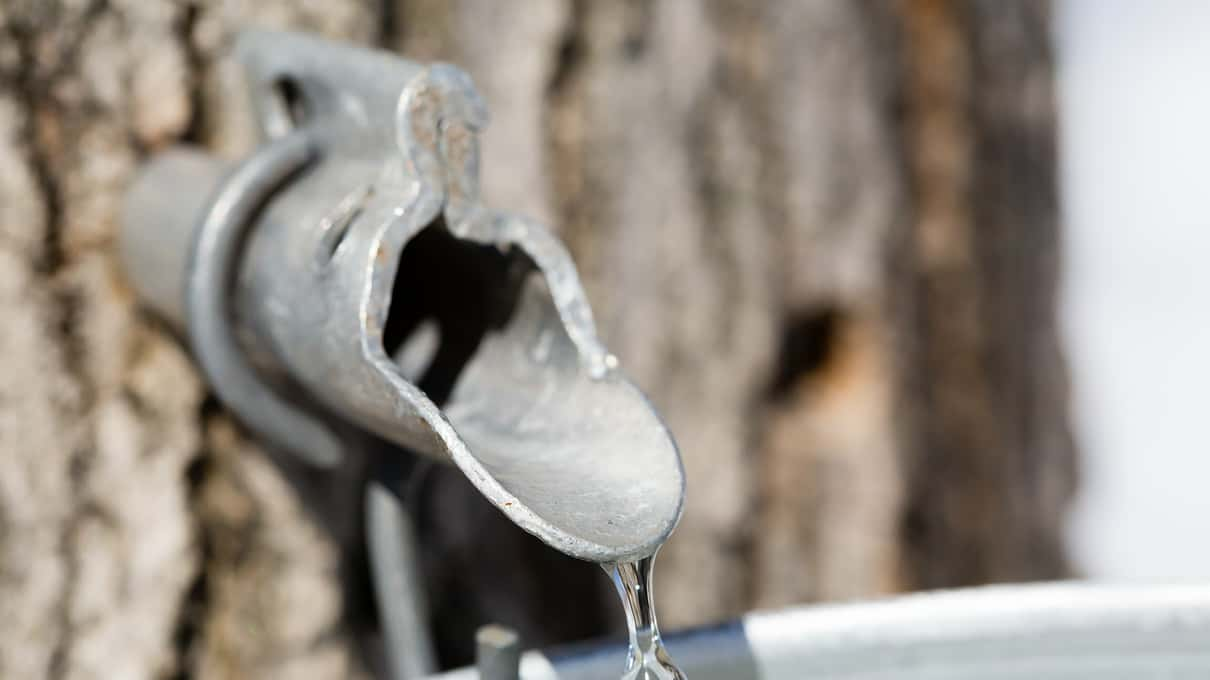
Today most sap travels from tree to building through plastic tubing. Buckets remain for show or on small farms, so don't feel cheated when the woods look as if someone has strung up a very long laundry line.
The boil, in numbers
Sap is only about 2% sugar, and syrup is about 66%. Everything between those two figures is water that has to leave as steam, which is why a working shack in spring can be seen from far off.
- Sap arrives from the trees, about 40 liters (10.5 gallons) for each liter of syrup
- It flows into an evaporator, a wide metal pan set over strong heat
- Water boils off while the liquid turns thicker, sweeter and darker
- At about 104 °C (219 °F) it has reached syrup and comes off the heat
- A few degrees more and it becomes the taffy that is poured on snow
That last step has an article of its own, taffy in every season. The building around the pan is what English speakers call a sugar house and Quebecers a cabane à sucre.
Those last degrees pass quickly, and sugar scorches if the pan runs low. Someone has to stay with it, which is how the long spring evening by the fire became part of the story.
The ratio also explains the price of a bottle in the shop. A tree gives its sap a drop at a time, and the great majority of every bucket drifts out through the roof.
Why one bottle is pale and the next nearly black
Color is the label's shorthand for taste. Sap from the start of the run tends to give lighter syrup, and later sap leans darker, so one sugar bush can fill several classes in a single spring.
| Color class | Taste word | How we'd use it |
|---|---|---|
| Golden | Delicate | On yogurt or vanilla ice cream |
| Amber | Rich | On pancakes, the everyday bottle |
| Dark | Robust | In baked beans or a glaze |
| Very dark | Strong | In baking, where it must fight other flavors |
Darker doesn't mean worse, only louder. To try four kinds in one sitting, the city tasting in Montreal pours them side by side, though it happens in a pastry shop without a tree in sight.
Older than the shacks
Indigenous peoples were making maple sugar long before French settlers arrived. The shack and its evaporator came afterward, together with the spring meals that visitors now associate with the word.
Quebec today produces roughly 70% of the world's maple syrup. Seen that way, the jug beside your pancakes is less a souvenir than a staple of the local economy.
What each visit shows you
Our pick for the process is the museum tour at Érablière Lac Beauport. The guided part covers the maple museum, in English or French as you choose at booking, with question time inside the hour, for ~$12. You need no French and no meal booking to follow it.
It rates 4.9 from 36 reviews on GetYourGuide. Nothing boils outside the spring, so an October visit explains the work rather than showing it. Syrup, maple butter and taffy on snow are there to taste either way.
If the how is what you came for
The tour meets at the family's sugar bush at 200 Chem. des Lacs, Lac-Beauport. Come by your own car or by taxi, and settle the return ride before you leave Quebec City.
From Montreal the balance tips toward lunch. Guests on Concord's bus day at ~$138 remember a presentation of 5 to 20 minutes, and one spring guest on Gankor's private trip saw no process at all.
That isn't a reason to write them off, since the meal at the shack is what many people travel for. It is a reason to choose by purpose, and maple tours in Quebec, side by side shows which does what.
Questions that get good answers
A family that has worked the same woods for generations knows things no panel can hold. Save a few of these for the guided hour.
- When did the run start this past spring, and when did it stop
- How many taps are out there, and how far does the tubing reach
- Which color class does the family keep for its own kitchen
- What happens to a tap hole once the spout comes out
- What did the oldest object in the museum do
Those who want the drive itself planned can start with the Lac-Beauport directions, and those counting money with the price page. Either way, choose your Quebec sugar shack tour by the month you travel in.
If the calendar says summer, accept that the pans will be cold and go for the stories. The planning tips for a sugar bush visit on our home page cover the rest of the day.